
Inside a Professional Generator Diagnostics Service: What Gets Tested and Why
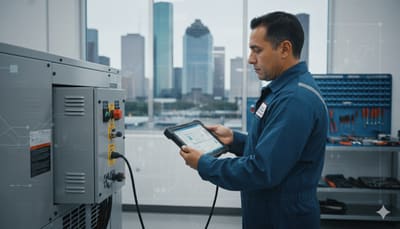
A generator diagnostics service is a structured inspection that tests each part of a backup power system, from the controller’s fault log to the transfer switch, to find out how healthy it really is and why it’s misbehaving if it is. This guide explains what a thorough diagnostic visit covers, how results should be reported and when it’s worth scheduling one in the Houston area.
If you’re trying to figure out whether your generator is showing warning signs in the first place, start with our article on signs your generator needs attention. This post covers what happens once a technician is on site.
In this guide
- What diagnostics is (and isn't)
- Controller and fault history
- Battery and charging system
- Fuel system
- Ignition and engine condition
- Cooling and lubrication
- Alternator output and electrical connections
- Transfer switch
- Load testing
- How results are reported
- When to schedule diagnostics
- How to prepare for the visit
- When to call a professional
What diagnostics is (and isn’t)
Routine maintenance swaps out consumables on a schedule. Diagnostics answers questions: Why does it shut down after twenty minutes? Why did it fail to transfer last week? Is this ten-year-old unit worth repairing? Will it carry the house if the outage lasts three days?
A good diagnostic visit works through the system in a logical order, measuring instead of guessing. It isn’t a quick look and a parts swap; replacing components until the problem goes away is expensive and often misses the real cause.
Controller and fault history
Modern generator controllers record events: failed starts, shutdowns, warnings and sometimes the conditions at the moment they happened. The technician reviews that history first, because it frequently points straight at the problem area. A string of overcrank events suggests starting or fuel trouble; a high-temperature shutdown points toward cooling; repeated low-voltage warnings suggest a charging issue.
The controller’s settings are also checked: exercise schedule, mode, time and date, and any parameters that affect start-up and transfer timing.
Battery and charging system
The starting battery is one of the most common failure points, and Houston heat is hard on batteries. Diagnostics goes beyond a quick voltage reading:
- Battery voltage at rest and while cranking, plus a load or conductance test
- Terminals and cables checked for corrosion, looseness or heat damage
- Battery charger output verified, since a failed charger slowly kills a good battery
- Battery age noted against the manufacturer's replacement guidance
Fuel system
What gets checked depends on the fuel type. For natural gas and propane units, the technician looks at supply pressure at the generator, especially under load when other gas appliances are running, along with regulators, shutoff valves and connections. For diesel, tank level, signs of water or microbial growth, fuel filters and lift pump operation are evaluated. For gasoline portables, stale fuel and gummed carburetors are the usual suspects.
Any smell of fuel or visible leak is treated as a priority finding.
Ignition and engine condition
On spark-ignited engines, spark plugs, ignition coils and wiring are inspected for wear and correct performance. The engine is also checked for the signs that tell a technician a lot about its overall health: how it cranks and starts, idle and running stability, unusual noises or vibration, exhaust color and any evidence of oil consumption or leaks. Belts, hoses and mounts are inspected for wear.
Cooling and lubrication
Liquid-cooled generators get a check of coolant level and condition, hoses, radiator fins for blockage, fan operation and, where present, the block heater. Air-cooled units need clear airflow paths, which in practice means checking for leaves, nests and debris inside the enclosure.
Oil level, condition and any leaks are inspected, and the low-oil-pressure and high-temperature shutdowns are verified where practical. These protective shutdowns save engines, but only if they work.
Alternator output and electrical connections
With the engine running, the technician measures voltage and frequency to confirm they are stable and within specification, and checks phase balance on three-phase systems. Problems here show up as flickering lights, equipment that trips or shuts down, or electronics behaving oddly.
Connections in the generator and its circuit breaker are inspected for tightness, discoloration and corrosion. On commercial systems, thermal imaging may be used to spot hot connections under load.
Transfer switch
A generator that runs perfectly but can’t transfer is no help in an outage. The transfer switch is tested by simulating a utility failure so the full sequence can be observed: utility loss detected, generator start signal, transfer once output is stable, then retransfer and cooldown when utility power returns. Contacts, mechanisms and wiring are inspected, and timing settings are reviewed.
Load testing
Many problems only appear under load. A building load test runs the generator with the real household or facility load connected. On commercial systems, a load bank test uses a portable load bank to apply controlled, stepped loads, sometimes up to the generator’s full rating, regardless of how much the building happens to be drawing that day. Load testing confirms the generator can carry what it’s supposed to and helps reveal fuel delivery, cooling and voltage regulation issues that stay hidden at idle.
How results are reported
At the end of the visit, you should understand exactly where your system stands. A useful report:
- States what was testedSo you know the scope of the inspection.
- Lists findings by prioritySeparating urgent safety or reliability issues from items that can be planned for.
- Explains the causeIn plain language, not just a part number.
- Recommends next stepsWith an upfront quote before any repair work begins.
- Records readingsBattery, voltage, frequency and load results that become a baseline for future visits.
JaWilly Services explains findings clearly and provides transparent, upfront pricing with no hidden fees, so you can make decisions with the full picture.
When to schedule diagnostics
| Situation | Why diagnostics helps |
|---|---|
| Generator won’t start, shuts down or shows a fault | Finds the actual cause before parts are replaced |
| Before hurricane season | Confirms readiness while there is time to fix problems |
| After a long run, storm or flooding | Checks for damage and wear from heavy use or water exposure |
| Buying a home or property with a generator | Reveals condition before you take ownership |
| Older unit, deciding repair vs. replace | Gives a factual basis for the decision |
| Commercial system with inspection or record needs | Documents performance under load |
How to prepare for the visit
A little preparation helps the technician get to the answer faster:
- Write down the symptoms. Note when the problem started, whether it happens every time or only sometimes, and anything you heard, smelled or saw. Intermittent problems are the hardest to catch, so your notes matter.
- Photograph the controller. Pictures of any fault codes or warning lights are useful, especially if the message clears itself later.
- Gather paperwork. Installation documents, past service records and the owner’s manual help the technician understand the system’s history and the manufacturer’s specifications.
- Make access easy. Clear plants, storage and debris from around the unit and the transfer switch, secure pets and share gate codes ahead of time.
- Plan for a brief interruption. Testing the transfer switch or running a building load test may involve a short planned power interruption. Businesses should schedule around critical operations and let staff know in advance.
When to call a professional
Owners can safely read a fault code, check fuel and look for obvious leaks; our generator troubleshooting guide lists those checks. Anything involving the controller, fuel system, electrical connections, transfer switch or load testing should be handled by a trained technician.
JaWilly Services offers professional generator diagnostics for residential and commercial systems across Houston, Katy, Sugar Land, The Woodlands, Pearland, Pasadena and surrounding communities, and our certified technicians work on most major makes and models. Learn more about our generator diagnostics service, ask about support for business and facility generators, or contact us to book a visit. If your generator has failed during an outage, call or text 832-418-7218 any time for 24/7 emergency support.