
How to Maintain a Generator: A Practical Owner's Checklist for Reliable Backup Power
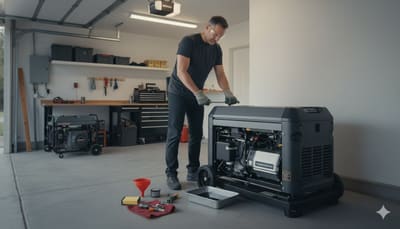
If you want to know how to maintain a generator, the short answer is this: check it regularly, change the oil and filters on the manufacturer’s schedule, keep the battery and fuel fresh, and let it run on a routine so problems show up before an outage does. The rest of this guide breaks those habits into a weekly, monthly and annual checklist you can actually follow, with clear notes on where owner care ends and professional service begins.
In this guide
Before you start: safety and your manual
Every generator is a little different, so your owner’s manual is the final word on intervals, oil grade, spark plug type and filter part numbers. Keep it handy, or download a copy from the manufacturer’s website using the model and serial number on the nameplate.
Before touching anything:
- Turn the generator off and let it cool. Exhaust parts and engine blocks stay hot for a while.
- On a standby unit, switch the controller to off or manual so it cannot start while your hands are inside the enclosure. Many manuals also call for removing the service fuse or disconnecting the battery.
- Never service a generator indoors or run it in a garage. Carbon monoxide is odorless and deadly.
- Keep a simple log: date, run hours and what you did. It helps you spot trends and helps any technician who works on the unit later.
Weekly checks
These take five minutes and catch most of the obvious problems.
- Look at the controller display for warnings, fault codes or a "not in auto" message on standby units.
- Confirm the standby generator's exercise cycle ran on schedule and sounded normal.
- Walk around the unit: clear leaves, mulch, grass clippings, wasp nests and anything stacked against the vents.
- Look underneath for fresh drips of oil, coolant or fuel.
- Make sure nothing has been built, planted or parked too close to the exhaust side.
Monthly tasks
Once a month, go a little deeper.
- Check the oil level with the dipstick and top off with the grade your manual specifies.
- Inspect the air filter for dust, debris or damp spots.
- Check the battery terminals for corrosion and make sure the cables are tight.
- Start portable generators and run them for a short period under a light load, such as a work light or fan.
- On liquid-cooled units, check the coolant level in the overflow reservoir when the engine is cold.
- Test the carbon monoxide alarms in your home.
Annual and run-hour service
Most maintenance is tied to either the calendar or run hours, whichever comes first. A typical annual service includes:
- Change the oil and oil filterDrain warm oil, replace the filter if your engine has one and refill to the full mark with the correct grade.
- Replace the air filterA clogged filter starves the engine of air, which hurts power and fuel economy.
- Replace or inspect spark plugsCheck the gap against the manual's spec. Fouled or worn plugs cause hard starting.
- Test the batteryA load test tells you far more than a voltage reading. Many owners replace starting batteries on a regular schedule rather than waiting for failure.
- Inspect belts, hoses and wiringLook for cracking, chafing, loose connections and rodent damage.
- Check the transfer switchOn standby systems, a full transfer test confirms the switch actually moves your home to generator power and back.
In the Houston area, it makes sense to finish annual service in spring, before hurricane season starts on June 1. Heat and humidity are hard on batteries and electrical connections, which our guide to maintaining a generator in Houston’s climate covers in more detail.
After a long outage, service sooner. If your generator ran for days during a storm, it may have used up a full oil change interval or more. Check the hour meter and change the oil and filters once the grid comes back, rather than waiting for the calendar date.
How to maintain a generator, component by component
Oil
Oil is the single most important consumable. Low or degraded oil causes most premature engine wear, and many generators have a low-oil shutdown that will stop the unit in the middle of an outage. Use only the oil type and viscosity listed in your manual.
Air filter
Air-cooled generators sit outdoors and pull in dust, pollen and debris. Paper filters get replaced, while foam pre-filters can often be washed, dried and lightly oiled per the manual. Never run the engine without a filter installed.
Spark plugs
Plugs wear gradually. A plug that is fouled with carbon, cracked or out of gap is a common cause of rough running and hard starting. Keep a spare of the correct type on hand.
Battery
Standby generators rely on a battery to crank the engine, and a weak battery is one of the most common reasons a unit will not start. Keep terminals clean and tight, and note the battery’s install date on the unit or in your log. Portable units with electric start have smaller batteries that benefit from a maintainer if stored for long periods.
Cooling and ventilation
Air-cooled units need clear airflow around the enclosure. Liquid-cooled units need correct coolant levels, a clean radiator and sound hoses. Overheating shutdowns are often caused by blocked airflow rather than a mechanical fault.
Fuel care for portable generators
Gasoline begins to degrade within weeks, especially in heat. Ethanol-blended fuel absorbs moisture and can gum up carburetors. To keep a portable ready:
- Add fuel stabilizer when you fill a storage can, not after the fuel has aged.
- Run the engine for a few minutes after adding stabilizer so treated fuel reaches the carburetor.
- For long storage, follow the manual: either store with a full, stabilized tank or drain the tank and run the carburetor dry.
- Rotate stored fuel and label cans with the fill date.
- Dual-fuel owners can rely on propane for storage, since it does not go stale, but still exercise the gasoline side occasionally.
Keeping a maintenance log
A simple record turns maintenance from guesswork into a routine. It does not need special software. A notebook kept with the generator supplies, a note on your phone or a spreadsheet all work, as long as you update it every time you touch the unit.
Record these details:
- Date and current hour meter reading
- Task performed, such as an oil change, filter swap or battery test
- Parts and fluids used, including oil grade and filter part numbers
- Any fault codes, warnings or unusual sounds you noticed
- Battery install date and the date of its last test
- Dates of professional service visits and what was found
The log pays off in several ways. It tells you when the next oil change is due by hours, not just by calendar. It shows patterns, like a battery that weakens every summer or a recurring warning after exercise cycles. And it gives any technician who works on the unit a head start, which can shorten a diagnosis. If your generator is still under a manufacturer’s warranty, maintenance records can also help show that the unit was cared for as required.
What to leave to a professional
Owner checks keep a generator healthy between visits, but some work needs tools, training and test equipment:
- Valve clearance adjustments and internal engine repairs
- Gas line, regulator and fuel solenoid work
- Control board, sensor and voltage regulator diagnosis
- Transfer switch inspection, cleaning and repair
- Load testing to confirm the generator can carry its rated output
- Any work inside your electrical panel
If a routine check turns up a fault code, a leak or a battery that will not hold a charge, our generator diagnostics service can pin down the cause. For replacement filters, batteries and other components, we source OEM-approved generator parts for most major makes and models.
When to call a professional
Book professional maintenance at least once a year, and sooner if your unit protects medical equipment, runs often or sat through a long outage. JaWilly Services provides routine maintenance and repairs for residential and commercial generators across Houston and nearby communities like Katy, Sugar Land and The Woodlands.
Standard appointments are available Monday through Friday from 8:00 AM to 5:00 PM, and emergency support is available 24/7 at 832-418-7218 by call or text. Contact us to schedule a maintenance visit, or browse our full list of generator services.