
When Your Generator Fails Mid-Outage: A Houston Guide to 24/7 Emergency Generator Repair
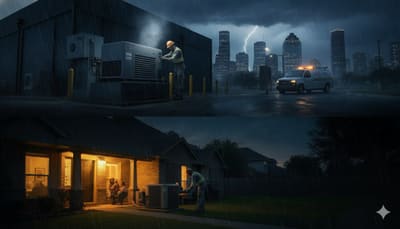
When a generator dies in the middle of a Houston outage, the order of your next moves matters: protect people first, run a few safe checks second, then call for 24/7 emergency generator repair with the right details in hand. This guide walks through exactly that, plus what happens once a technician arrives and how to keep it from happening again.
In this guide
Safety first: the two hazards that matter most
A silent generator is frustrating, but a generator that is running in the wrong place, or wired the wrong way, is dangerous. Before you touch anything, deal with these two risks.
Carbon monoxide
Every fuel-burning generator produces carbon monoxide (CO), a gas you cannot see or smell. When a standby unit fails, people often drag out a portable generator and set it in the garage “just for a few minutes” or under a patio to keep it out of the rain. That is how CO poisonings happen after storms.
Never run a portable generator indoors, in a garage (even with the door open), in a carport or under an enclosed patio. Keep it well away from doors, windows and vents, with the exhaust pointed away from the house. If anyone feels dizzy, nauseous or confused, get everyone into fresh air and call 911.
Make sure your CO alarms have working batteries. During a long outage, hardwired detectors without battery backup will not protect you.
Backfeed
Backfeed happens when generator power flows out through your home’s wiring and onto the utility lines. It can seriously injure line workers trying to restore service and can damage the generator when grid power comes back. The usual cause is a portable generator plugged into a dryer or wall outlet with a male-to-male cord. A properly installed transfer switch or approved interlock is the only safe way to feed household circuits from a generator.
If your standby generator’s transfer switch is buzzing, smells hot or shows scorch marks, do not reset it or open the panel. Turn the generator off at its controller if you can do so safely and leave the switch alone for the technician.
Five-minute checks before you call
Many emergency calls turn out to be something an owner could have spotted quickly. These checks are safe for most homeowners and facility staff, need no tools and do not involve opening electrical enclosures.
- Read the controllerMost standby generators have a display or status lights. Write down or photograph any fault code or message, such as overcrank, low oil pressure, overspeed or high temperature. That code is the single most useful clue you can give a technician.
- Check the mode switchThe controller should be in Auto. Units are sometimes left in Off or Manual after a service visit or a test, and they will not respond to an outage in those modes.
- Look at the generator's main breakerIf the breaker on the unit has tripped, the engine may run while the house stays dark. Note whether it was tripped; one reset is reasonable, but if it trips again, stop.
- Confirm fuelFor propane, check the tank gauge. For natural gas, see whether other gas appliances work. For diesel or gasoline, check the tank level. Running out mid-outage is more common than people expect.
- Check oil and look for leaksOn units with an accessible dipstick, a low reading will trigger a protective shutdown. Puddles of oil, coolant or fuel under the unit are worth photographing.
If these checks don’t solve the problem, or if anything looks burned, wet inside, or damaged by debris or floodwater, stop and call. A generator that has been under water should not be started until it has been inspected.
Why generators fail during outages
Outages are exactly when hidden weaknesses come out, because the generator is suddenly asked to run for hours under real load after months of short test cycles. These are the failures technicians see most often on emergency calls in the Houston area.
| Symptom | Common causes |
|---|---|
| Won’t crank at all | Weak or dead starting battery, corroded terminals, failed battery charger, controller fault |
| Cranks but won’t start | No fuel or low fuel pressure, stale gasoline, clogged filter, ignition or spark plug problems |
| Starts, then shuts down | Low oil pressure, overheating, overspeed or underspeed fault, fuel starvation under load |
| Runs, but no power to the building | Tripped generator breaker, transfer switch failure, loose or damaged wiring |
| Lights flicker or surge | Overloading, governor or voltage regulator trouble, fuel delivery problems |
Two local factors make these worse. Summer heat shortens battery life and pushes cooling systems hard, so an engine that idles fine during a ten-minute exercise can overheat after hours at full load in August. And long gaps between real use let gasoline go stale in portable units and let small leaks, rodent damage and corrosion go unnoticed. Winter Storm Uri in February 2021 and Hurricane Beryl in July 2024 both caused long, widespread outages across the Houston area, exactly the kind of extended run that exposes weak spots.
What to tell the technician
A clear description lets the technician bring the right parts and skip guesswork. When you call or text JaWilly Services at 832-418-7218, have this ready:
- Make, model and approximate size (kW) from the data plate
- Fuel type: natural gas, propane, diesel or gasoline
- Any fault code or warning light, ideally with a photo
- What happened just before it failed: sounds, smells, smoke, flickering
- Whether it has run recently and when it was last serviced
- Whether you are a home or business, and what loads are critical
- Address, gate codes and where the unit is located on the property
If someone in the home depends on powered medical equipment, or a business has refrigerated stock or other time-sensitive needs, say so up front. That context helps with prioritizing during a widespread outage.
What happens on an emergency repair call
Every situation is different, but a professional emergency visit generally follows the same pattern.
- Make the site safe. The technician confirms the unit’s location, ventilation and transfer switch status before working on anything, and checks for fuel leaks or water intrusion.
- Read the evidence. Fault history on the controller, battery voltage under cranking, fuel supply and oil condition usually narrow the problem down quickly. For a deeper look at this process, see our guide to professional generator diagnostics.
- Explain the options. You should hear what failed, what it will take to get power back now and whether anything else needs attention later. JaWilly Services provides upfront quotes with no hidden fees, so you can approve the work knowing the cost.
- Repair or stabilize. Common fixes like a battery, charger, filter, spark plugs or a fuel issue can often be handled on site. Some repairs need a part that has to be ordered; in that case the goal is to get you safely through the outage and then complete the permanent repair. Our generator parts and replacement service uses OEM-approved components.
- Test under load. A generator that idles isn’t proven. The unit should be run with the building’s load on it, with the transfer switch confirmed to transfer and, once utility power is restored, transfer back.
Getting through the wait
During a major storm, demand for repair spikes across the whole region, from Katy to Pasadena. While you wait:
- Keep refrigerator and freezer doors closed as much as possible.
- Move medications that need refrigeration to a cooler with ice if the outage drags on.
- In summer heat, keep vulnerable family members in the coolest room, hydrate and consider a cooling center if conditions get dangerous.
- Unplug sensitive electronics so a surge when power returns doesn’t damage them.
- Don’t let anyone open the generator enclosure or transfer switch to “take a look.”
Preventing the next emergency
Most emergency repairs trace back to something that could have been caught on a calm day. A few habits make a real difference:
- Watch the weekly exercise. If your standby unit runs a scheduled self-test, glance at it now and then. Listen for rough running and check for new fault messages.
- Replace the battery on schedule. Heat is hard on batteries, and a weak battery is one of the most common reasons a generator won’t start.
- Book service before hurricane season. Atlantic hurricane season runs June 1 through November 30. A spring inspection gives time to fix anything found. Our hurricane season generator checklist lays out the timing.
- Follow the manufacturer’s maintenance schedule for oil, filters and plugs, based on run-hours or calendar time.
- Test under real load occasionally. A test with the house or building load connected reveals problems a no-load exercise misses.
When to call a professional
Call for emergency service whenever the generator won’t run after the basic checks, shows a fault you don’t understand, trips its breaker again after a reset, smells of fuel or burning, or has been exposed to floodwater. Never open the transfer switch or controller enclosure yourself.
JaWilly Services offers 24/7 emergency generator support for homes and businesses across Houston, Katy, Sugar Land, The Woodlands, Pearland, Pasadena and surrounding communities. Our certified technicians work on most major makes and models. Learn more about our emergency generator support, or contact us any time; call or text 832-418-7218, day or night.