
Best Generators for Backup Power: Comparing Generator Types by How You'll Use Them
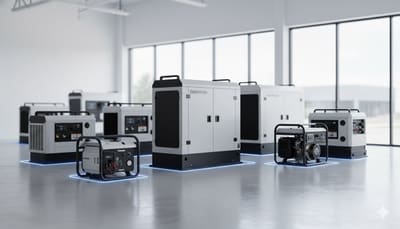
The best generators for backup power are not one brand or model. They are the type of generator that fits how long your outages last, what you need to run and how much hands-on work you are willing to do in a storm. This guide compares the main generator types side by side, explains which use case each one wins, and lists the features worth paying attention to.
In this guide
How to judge “best” for your situation
Before comparing hardware, answer four questions:
- What must stay on? A refrigerator and a few lights is a very different job than central air, a well pump and a home office.
- How long do your outages last? A few hours after a thunderstorm favors simple options. Multi-day outages like those after Hurricane Beryl in July 2024 favor fuel supplies you don’t have to haul.
- Who will be there to run it? An automatic system works when you’re traveling or asleep. A portable needs someone to set it up, connect it and refuel it.
- Where can it safely sit? Placement rules, noise, flood risk and carbon monoxide distance all limit your choices.
Sizing deserves its own deep dive, so if you have not yet added up your loads, our guide to sizing a generator walks through running and starting watts.
Home standby generators: air-cooled vs liquid-cooled
A home standby generator is permanently installed on a pad outside, connected to natural gas or a propane tank, and wired through an automatic transfer switch. When the utility fails, it starts and takes over the load on its own, then shuts down after power returns.
Air-cooled standby units use a fan to cool the engine, much like a lawn mower engine on a larger scale. They are the most common choice for small and mid-sized homes, are relatively compact and cost less to buy and maintain than liquid-cooled models.
Liquid-cooled standby units use a radiator and coolant like a car engine. They are built for higher outputs, longer continuous run times and heavier loads, which is why you see them on large homes and light commercial sites. They tend to run at lower engine speeds, which often means less noise and longer engine life, but they cost more and need coolant system maintenance.
Best for: households that want hands-off protection, people who travel, anyone with medical equipment, and homes where heat during a summer outage is a real health risk.
Trade-offs: highest upfront cost, professional installation and permits, and routine maintenance. Natural gas units also depend on the gas supply staying up.
Conventional portable generators
A portable generator is a gasoline (or dual-fuel) engine and alternator on a frame with wheels. You roll it out, start it, and power appliances through heavy-duty extension cords or, much better, a properly installed transfer switch or interlock with an inlet box.
Best for: budget-conscious homeowners who need meaningful wattage for essentials like a refrigerator, freezer, sump or well pump, fans and a window air conditioner, and who are home to manage it.
Trade-offs: you have to store and rotate fuel, refuel it often during long outages, and keep it well away from the house because of carbon monoxide. Conventional portables are loud and their power can be rougher than an inverter’s, which matters for some electronics.
Inverter generators
An inverter generator produces AC power, converts it to DC and then back to clean, stable AC. The engine can throttle up and down with demand rather than running at a fixed speed.
Best for: sensitive electronics, quiet neighborhoods, short outages, RVs and tailgating. Many models can be paired with a second unit for more output.
Trade-offs: smaller fuel tanks and lower total output than a conventional portable of similar price. Most cannot start a central air conditioner without help.
Dual-fuel and tri-fuel models
Dual-fuel generators run on gasoline or propane; tri-fuel units add natural gas. They come in both conventional and inverter designs.
Fuel flexibility is a genuine advantage around Houston. After a major storm, gas stations may be closed or have long lines, while propane cylinders store for long periods without going stale the way gasoline does. A tri-fuel unit connected to a natural gas stub can run without refueling at all, though connecting to a gas line should be done by a qualified professional.
Trade-offs: output is usually somewhat lower on propane and natural gas than on gasoline, so check the manufacturer’s ratings for each fuel.
Propane brings its own considerations. Larger cylinders are heavy to move, connections and regulators should be checked for leaks every time you hook one up, and stored cylinders belong outdoors and upright, away from the house. Many owners keep several filled cylinders on hand at the start of hurricane season so the generator can run for a while without a trip to a gas station.
Battery power stations
A portable power station is a large rechargeable battery with an inverter and outlets built in. Some systems can be expanded with extra battery packs or charged from solar panels.
Best for: short outages, apartments and condos, and small critical loads such as a CPAP, phones, a modem or a few lights. With no exhaust, they can be used indoors.
Trade-offs: limited stored energy. Once it is drained, it needs recharging from the grid, solar panels or a generator. Running a refrigerator for days or a central air system is beyond most units. Permanently installed home battery systems are a separate, larger category, often paired with solar.
Best generators for backup power by use case
| Generator type | Starts automatically | Typical fuel | Noise | Best use case |
|---|---|---|---|---|
| Air-cooled home standby | Yes | Natural gas or propane | Moderate | Whole-home or essential-circuit backup for most homes |
| Liquid-cooled standby | Yes | Natural gas, propane or diesel | Often quieter than air-cooled; varies by enclosure | Large homes, heavy loads, light commercial |
| Conventional portable | No | Gasoline (some dual-fuel) | Loud | Budget backup for essentials with a transfer switch |
| Inverter generator | No | Gasoline or propane | Quiet | Electronics, short outages, quiet neighborhoods |
| Dual-/tri-fuel portable | No | Gasoline, propane, natural gas | Moderate to loud | Fuel flexibility after storms |
| Battery power station | No engine to start | Grid or solar recharge | Silent | Indoor use, small loads, short outages |
Features worth paying for
Whatever type you choose, a few features separate a frustrating backup system from a dependable one:
- Automatic transfer switch (standby) or a properly installed manual transfer switch or interlock (portable), so you never backfeed the grid
- Load management modules that shed big loads like a second AC unit or water heater, letting a smaller generator protect the whole house
- Remote monitoring through Wi-Fi or cellular so you can see status, exercise results and alerts from your phone
- Automatic weekly exercise with clear fault codes on the controller
- Electric start on portables, with a battery you keep charged
- CO detection and auto-shutoff, now common on many portable models
- Weather-resistant enclosure and corrosion protection suited to Gulf Coast humidity
- Local service support and parts availability for the make you buy
A generator that is easy to maintain and easy to get serviced will outperform a fancier unit that sits neglected.
When to call a professional
Portable generators and power stations can be owner-operated, but connecting any generator to your home’s wiring, installing a standby unit, or running a gas line calls for qualified professionals and the right permits. JaWilly Services handles residential generator installation, maintenance and repair on most major makes and models, and supports businesses through our commercial generator services. We serve Houston, Katy, Pearland and surrounding communities with upfront quotes and no hidden fees.
Not sure which type fits your home? Get in touch or call or text 832-418-7218.