
Emergency Power Solutions in Houston: Comparing Your Backup Power Options
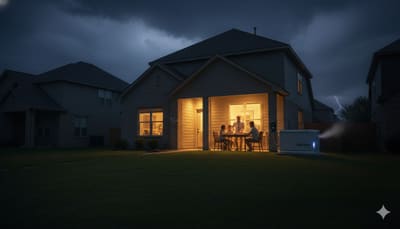
The main emergency power solutions Houston property owners choose between are permanent standby generators, portable generators connected through a transfer switch or interlock, small inverter generators and battery storage systems. Each one fits a different budget, level of convenience and outage length. Below we compare them side by side and match each to the kinds of outages the Houston area actually sees.
In this guide
The outages Houston plans for
Backup power is not one-size-fits-all because outages are not one-size-fits-all. Around Houston, they tend to come in three flavors:
- Tropical systems. Atlantic hurricane season runs from June 1 through November 30. Hurricane Beryl in July 2024 left a huge share of the region in the dark, some households for many days, in peak summer heat.
- Hard freezes. Winter Storm Uri in February 2021 showed that cold snaps can cause long, grid-wide outages here too, with frozen pipes and dangerous indoor temperatures.
- Sudden wind events. Severe thunderstorms and derechos, like the one that tore through downtown Houston in May 2024, arrive with little warning and can snap lines and poles across whole neighborhoods.
A short storm outage and a multi-day post-hurricane outage call for very different equipment. Keep both scenarios in mind as you read through the options.
Whole-home standby generators
A standby generator sits permanently outside on a pad, connects to your natural gas line or a propane tank, and is wired to an automatic transfer switch. When utility power drops, the generator starts on its own and takes over within seconds. When power returns, it switches back and shuts down.
Strengths: no one has to be home, no refueling with a natural gas supply, can be sized to run central air and major appliances, and runs a scheduled self-test so problems are easier to catch early.
Trade-offs: the highest upfront investment of any option, requires professional installation, permits and placement planning, and needs routine maintenance like any engine.
For businesses, standby generators are the standard approach, often larger diesel or natural gas units sized for specific equipment. Our commercial generator services cover installation, maintenance and ongoing support for those systems.
Portable generators with a transfer switch or interlock
A portable generator runs on gasoline, propane or both (dual-fuel models). On its own it powers whatever you plug into it with extension cords. Connected to a manual transfer switch or a breaker interlock kit through an exterior inlet, it can feed selected household circuits safely.
Strengths: a much lower entry cost, flexible, and can be stored when not needed. With an inlet and interlock, you can run a refrigerator, lights, a few outlets, a well pump or a window unit without a tangle of cords.
Trade-offs: someone has to wheel it out, start it and refuel it, often every several hours, in whatever weather is happening. Gasoline goes stale and can be hard to find after a hurricane. Most portables cannot run a whole house with central air.
Carbon monoxide kills. Run portable generators outdoors only, well away from doors, windows and vents, and never in a garage, even with the door open. Install battery-powered CO alarms inside the home. Never back-feed your house through a wall outlet.
Inverter generators
Inverter generators are a subtype of portable unit. They produce cleaner, more stable power, which is gentler on laptops, phones, medical devices and modern electronics. They are also noticeably quieter and adjust engine speed to the load, which stretches fuel further.
Strengths: quiet, fuel-efficient, lightweight, and safe for sensitive electronics.
Trade-offs: lower output than a conventional portable of similar size, so they are best for essentials rather than heavy loads. Some models can be paired to double capacity.
Inverters make sense for apartments with balconies, for small essentials-only plans, or as a supplement to a larger system.
Battery storage systems
Home battery systems store energy from the grid or from rooftop solar and release it during an outage. They switch over almost instantly, run silently and produce no exhaust.
Strengths: no fuel, no fumes, no noise, very little routine maintenance, and seamless switchover for electronics and Wi-Fi.
Trade-offs: runtime is limited by stored energy. Central air conditioning in a Houston August drains batteries fast, and without strong sun to recharge, a multi-day outage can outlast them. Many owners use batteries for short outages and pair them with a generator for long ones.
Side-by-side comparison
| Option | Starts automatically | Typical coverage | Fuel / energy | Best for |
|---|---|---|---|---|
| Whole-home standby | Yes | Whole house or large selected loads | Natural gas, propane or diesel | Long outages, homes with medical needs, businesses |
| Portable + transfer switch or interlock | No | Selected circuits | Gasoline, propane or dual-fuel | Budget-conscious homes covering essentials |
| Inverter generator | No | A few appliances and electronics | Gasoline or propane | Small households, sensitive electronics, quiet settings |
| Battery storage | Yes | Selected loads, limited by capacity | Grid or solar charging | Short outages, quiet operation, solar homes |
Runtime, fuel and upkeep
Coverage on paper means little if the system runs out of fuel or stored energy halfway through an outage. Before choosing, think through what keeps each option going on day three.
- Natural gas standby units draw from the utility supply, so runtime is usually limited by maintenance intervals rather than fuel. Long outages still call for oil checks once the hour meter climbs.
- Propane systems run as long as the tank lasts. Know your tank size, keep it reasonably full during hurricane season and understand that refill deliveries can be slow after a major storm.
- Gasoline portables need fresh fuel every several hours of running. Stations may be closed or have long lines after a hurricane, and storing large amounts of gasoline at home carries its own hazards.
- Batteries last as long as their stored energy. Solar can recharge them, but cloudy post-storm days slow that down.
Every engine-driven option also needs routine upkeep to start reliably when called on. A standby generator that has not been serviced in years is not much of a plan. Our owner’s checklist on how to maintain a generator covers the basics, and professional maintenance fills in the rest.
Matching emergency power solutions to Houston outage risks
Start with what would hurt most if the power stayed off for three days. Then work backward:
- Medical equipment or vulnerable family members: lean toward a standby generator, possibly paired with a battery for instant switchover.
- Frequent travel or a second home: automatic operation matters, so standby or battery storage.
- Flood-prone lots: whatever you choose must sit above expected water levels, which affects placement and sometimes the choice itself.
- Tight budget, essentials only: a dual-fuel portable with a properly installed inlet and interlock covers a lot of ground.
- Businesses with inventory, data or life-safety loads: commercial standby with a maintenance program and documented testing.
Location plays a role too. Heavily wooded areas like The Woodlands see more tree-related line damage during storms, while lower-lying parts of Pearland and the coastal side of the metro need to think hard about flood elevation. If you have already settled on a generator and need help with sizing, fuel type and placement, our step-by-step guide on how to choose an emergency generator goes deeper.
When to call a professional
Any option that ties into your home’s electrical panel, including standby generators, transfer switches, interlocks and battery systems, should be installed by qualified professionals with the proper permits. Gas line connections are never a do-it-yourself job.
JaWilly Services installs residential generators, provides commercial generator installation and maintenance and repairs most major makes and models across Houston, Katy, Sugar Land, The Woodlands, Pearland and Pasadena. If an existing system is not working, our 24/7 emergency generator support line is open around the clock. Call or text 832-418-7218, or send us a request and we will help you choose the right backup plan.