
How to Choose an Emergency Generator: A Houston Decision Guide for Homes and Businesses
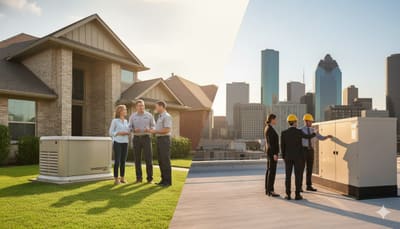
Learning how to choose an emergency generator is mostly about making five decisions in the right order: what you need to power, which type of generator fits that need, which fuel you can rely on, where the unit will safely sit, and how it will connect to your building. Get those right and the brand and model choice becomes much simpler. This guide walks Houston homeowners and business owners through each decision with the local conditions in mind.
In this guide
Step 1: Decide what to back up
Before looking at a single generator, write down what has to keep working when the grid goes down. Most lists fall into three tiers:
| Tier | Home examples | Business examples |
|---|---|---|
| Critical | Medical devices, refrigerator, sump pump, a few lights, phone charging | Life-safety systems, refrigeration, security, network equipment |
| Comfort | Central air or a window unit, water heater, cooking | HVAC for occupied areas, lighting, point-of-sale |
| Everything | The whole house as if nothing happened | Full operations, including heavy equipment |
In Houston, air conditioning is usually the deciding factor. Summer outages after a hurricane can turn a house dangerously hot, and central air is one of the largest loads in most homes. Deciding whether you want to run it, and how much of the house it needs to cool, shapes nearly every choice that follows.
Once you have the list, you or an installer can total the wattage, including the extra starting surge that motors and compressors draw. We cover the math in our separate guide on what size generator you need, so here we will focus on the other decisions.
Step 2: Standby or portable
Your load list usually points clearly to one type:
- Standby generators are permanently installed, start automatically and can be sized to run a whole home or a commercial building. They make sense when you want comfort-tier or everything-tier coverage, when someone in the home depends on medical equipment, or when nobody may be around to start a generator.
- Portable generators are best for critical-tier loads on a budget. They require someone to set them up outdoors, start them and refuel them during the outage.
- Inverter generators are quieter portables with cleaner power for electronics, suited to a small set of essentials.
If you are still weighing generators against battery storage and other options, our overview of emergency power solutions in Houston compares them side by side.
Step 3: Choose a fuel type
Fuel availability during a long outage matters as much as runtime on paper.
| Fuel | Common use | Advantages | Watch-outs |
|---|---|---|---|
| Natural gas | Home and light commercial standby | Piped from the utility, no refueling or storage | Requires gas service and adequate meter and line size |
| Propane | Standby where gas is unavailable, dual-fuel portables | Stores for long periods without going stale | Tank size limits runtime, and refills depend on delivery |
| Diesel | Larger commercial standby | Energy-dense, well-suited to heavy loads | Stored fuel needs quality management and periodic testing |
| Gasoline | Portables | Easy to find in normal times | Degrades quickly, hard to store safely, scarce after storms |
Dual-fuel portables, which run on gasoline or propane, give flexibility. For permanent standby systems in neighborhoods with gas service, natural gas is the most common choice because there is nothing to haul or store.
Step 4: Plan placement, noise and flood height
Where the generator sits affects safety, neighbors and the life of the equipment.
- Exhaust clearance: keep the unit away from doors, windows, soffit vents and air intakes per the manufacturer's clearance requirements. Carbon monoxide is the biggest generator hazard.
- Flood elevation: much of the Houston area is flat and low-lying. Place the generator, and ideally the transfer switch, above your expected flood level, using a raised pad or platform if needed.
- Noise: check the decibel rating. Bedroom windows, patios and the neighbor's house all deserve consideration, and some HOAs set limits.
- Service access: technicians need room to open the enclosure and reach filters, the battery and the controller.
- Proximity to utilities: shorter runs to the gas meter and electrical panel usually simplify installation.
- Debris and trees: in heavily wooded areas such as The Woodlands, avoid placing units where falling limbs or heavy leaf litter will collect.
Step 5: Plan the transfer switch connection
Every generator that powers building circuits needs a safe way to connect. The transfer switch isolates your building from the utility so power cannot flow back onto the lines and endanger line workers.
- Automatic transfer switches pair with standby generators. They detect an outage, start the generator and switch over without anyone touching anything.
- Manual transfer switches or breaker interlock kits with an exterior inlet are used with portable generators. You start the generator, plug it in and flip the switch.
- A whole-house transfer switch covers the full panel, while a managed or essential-circuit setup powers selected circuits, which can allow a smaller generator.
Never back-feed a building through a dryer or wall outlet. It is unsafe and against code.
Permits, HOAs and codes
Permanent installations in the Houston area generally need permits, typically for the electrical work and often for the gas connection. Rules vary between the City of Houston and surrounding cities and counties, such as Katy, Sugar Land, Pearland and Pasadena, so check with your local permitting office.
Many neighborhoods also have HOA rules about placement, screening and noise. Submit plans early, because approval can take time. Commercial sites may face additional requirements, including codes such as NFPA 110 for certain emergency power systems in facilities like hospitals and care centers.
Budget factors to weigh
We will not quote prices here, because the total depends on your specific site. These are the factors that move the number most:
- Generator size and type, from small portable to large standby
- Transfer switch type, whole-house or managed-circuit
- Fuel connection, including whether a gas meter or line upgrade or a propane tank is needed
- Site work, such as a concrete or raised pad, trenching and distance to the panel
- Permits and inspections
- Ongoing maintenance, which every engine-driven generator needs to stay reliable
A clear, upfront quote that itemizes these factors makes it easy to compare options and avoid surprises.
How to choose an emergency generator without common mistakes
Most disappointing generator purchases trace back to a handful of avoidable errors:
- Buying during the storm. Shopping after a hurricane warning means limited stock, rushed decisions and no time for permits or installation. Plan in the off-season.
- Undersizing for air conditioning. A generator that cannot start your central air compressor may keep the lights on but leave the house unbearably hot.
- Ignoring fuel logistics. A large gasoline portable is only useful if you can store and buy enough fuel to keep it running for days.
- Placing the unit too close to the house. Convenience is never worth carbon monoxide risk. Follow the manufacturer’s clearances exactly.
- Skipping the transfer switch. Extension cords through a window are a stopgap, not a plan, and back-feeding is dangerous.
- Forgetting about maintenance. Every generator needs routine care. Budget the time and cost from day one, and use our owner’s checklist on how to maintain a generator to stay on track.
Avoiding these mistakes matters more than finding the perfect brand. A well-chosen, properly installed and regularly maintained generator from any reputable manufacturer will serve you far better than a premium unit installed in a hurry.
When to call a professional
Load calculations, gas sizing, transfer switch wiring and permits are where a professional earns their keep. JaWilly Services provides residential generator installation and commercial generator installation, maintenance and support, and works on most major makes and models. Explore our full list of generator services or check our service areas to confirm we cover your neighborhood.
When you are ready to talk through your load list and site, call or text 832-418-7218, or request a consultation. Standard appointments run Monday through Friday from 8:00 AM to 5:00 PM, with emergency support available 24/7.