
How Emergency Generator Systems Work, Step by Step
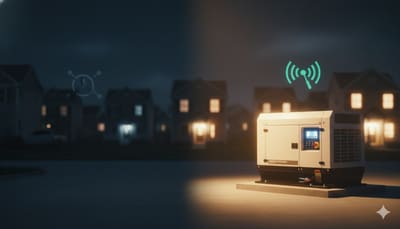
Understanding how emergency generator systems work comes down to one chain of events: the system notices utility power is gone, starts an engine, waits until the electricity it makes is stable, moves your circuits over, and then reverses everything once the grid is back. Each link in that chain is a separate component, and when a backup system lets someone down, it is almost always because one link failed. This guide walks through the sequence in order so you know what should be happening behind the enclosure.
In this guide
- The main components of an emergency generator system
- Step 1: Detecting the outage
- Step 2: Starting the engine
- Step 3: Stabilizing voltage and frequency
- Step 4: Transferring the load
- Step 5: Retransfer and cooldown
- Load shedding and load management
- Controllers, exercise cycles and remote monitoring
- When to call a professional
The main components of an emergency generator system
Before following the sequence, it helps to know the players. A permanently installed home or business standby system typically includes:
- Engine – burns natural gas, propane or diesel (some smaller units run on gasoline) to spin the alternator.
- Alternator – converts that rotation into AC electricity. Its speed sets the output frequency, which in the US must be held close to 60 Hz.
- Controller – the small computer, usually behind a door on the enclosure, that watches utility power, runs the start sequence, logs faults and schedules self-tests.
- Automatic transfer switch (ATS) – a heavy-duty switch, mounted near your main panel or electrical service, that decides whether your circuits are fed by the utility or the generator. It physically prevents both from being connected at the same time.
- Starting battery and battery charger – the battery cranks the engine; a charger (often built into the controller) keeps it topped up between events.
- Fuel supply – a gas line, propane tank or diesel tank, with regulators, valves and filters in between.
- Optional add-ons – load shedding modules, smart circuit managers and remote monitoring devices.
Portable generators share the engine and alternator but leave out the controller-driven automation. With a portable, you are the controller and you operate the transfer switch by hand.
Step 1: Detecting the outage
The ATS or controller continuously measures the voltage coming in from the utility. When it drops below a set threshold, or disappears entirely, a timer starts. That brief delay matters: the grid often blinks for a second or two during storms when protective devices on power lines reclose, and you do not want a generator firing up for every flicker.
If utility voltage is still missing when the timer runs out, the controller declares an outage and moves to the next step. Detection settings, including the voltage threshold and the delay length, are adjustable. Settings that are too sensitive cause nuisance starts; settings that are too relaxed can leave you in the dark longer than necessary.
Step 2: Starting the engine
The controller now sends a crank signal. The starter motor turns the engine using power from the starting battery, the fuel valve opens, and ignition (or compression, on a diesel) takes over. Most controllers try several crank cycles with short rests in between. If the engine still has not caught after the programmed attempts, the controller stops and posts an over-crank or failure-to-start alarm.
This is the stage where weak batteries, stale or interrupted fuel and ignition faults show up. A battery that seems fine in mild weather can lack the cranking power on a hot July afternoon or a rare Houston freeze. Diesel units serving facilities often add a block heater so the engine is warm enough to start and accept load quickly.
Step 3: Stabilizing voltage and frequency
An engine that just started is not ready to carry your house or building. The governor brings it up to its rated speed, and the voltage regulator adjusts the alternator’s magnetic field until output voltage is where it should be. The controller watches both values. Only when voltage and frequency are within acceptable limits does it allow a transfer.
Many systems also include a short engine warm-up delay here. On residential air-cooled units it is typically brief; commercial units may be configured differently depending on what they protect. Facilities that fall under emergency power standards such as NFPA 110 have specific requirements for how quickly power must be restored, which shapes how these delays are set.
Step 4: Transferring the load
With stable power available, the controller tells the ATS to switch. The transfer switch disconnects your circuits from the utility side and connects them to the generator side. In the most common “open transition” design, there is a very short break between the two sources, which is why your lights go out for a moment, come back, and clocks on some appliances reset.
The ATS is also a safety device. By making it mechanically impossible to connect the generator and the utility at the same moment, it prevents backfeed – power flowing out of your property onto lines that utility crews may believe are dead. This is the main reason a properly installed transfer switch or interlock is required for any generator that feeds a home’s wiring.
Transfer switches come in two broad styles. A whole-home or service-entrance ATS moves everything over at once. An essential-circuit ATS feeds a separate subpanel that holds only the circuits you chose to back up, such as the refrigerator, some lights and the furnace fan.
Step 5: Retransfer and cooldown
While the generator carries the load, the controller keeps watching the utility side. When power returns, it does not switch back immediately. A retransfer delay – often a few minutes – confirms the grid is stable and is not about to drop again as crews restore circuits.
Once that timer expires, the ATS moves your circuits back to utility power. The engine then keeps running with no load for a cooldown period, letting temperatures in the engine and turbocharger (on larger units) come down evenly before shutdown. After that, the controller returns to standby, the battery charger takes over, and the system waits for the next event.
What a healthy event looks like: a brief blackout, power back within seconds on generator, a second short blink when utility power returns several minutes after the grid is restored, and the generator running quietly for a few minutes more before stopping. If any part of that pattern is missing, it is worth having the system checked.
Load shedding and load management
A generator can only produce so much power. When a large motor load starts – a central air conditioner compressor is the classic example – it draws a surge many times its running current for a split second. If the generator is already close to its limit, that surge can drag voltage down or trip the generator’s breaker.
Load shedding modules solve this by watching the generator’s output and temporarily cutting off selected heavy loads when capacity is tight. Some work by interrupting the thermostat signal to an air conditioner; others use relays or smart breakers on circuits like electric water heaters, dryers or pool pumps. When the generator has headroom again, the shed load is reconnected after a short delay. Combined with soft-start kits on air conditioners, load management lets a properly sized generator cover more of a home without constant overloads.
Commercial systems take this further with priority levels, so life-safety and critical loads transfer first and less important loads follow only if capacity allows.
Controllers, exercise cycles and remote monitoring
The controller is also your system’s record keeper. Between outages it typically:
- runs a scheduled exercise cycle, starting the engine weekly or on another set interval to circulate oil, charge the battery and prove it can run;
- logs alarms such as low oil pressure, high temperature, over-crank, overspeed and low battery voltage;
- shows maintenance reminders based on hours of operation.
Many modern controllers connect to Wi-Fi or cellular networks so owners can see status and alerts on a phone. Remote monitoring is useful in a place like Houston, where you may be away when a storm rolls through, and it gives a technician a head start because the fault history is already known. It is not a substitute for physical inspection, though; an app will not show a cracked hose, corroded terminals or a wasp nest in the air intake.
When to call a professional
Because the system is a chain, a single weak link stops the whole thing. If your generator fails its exercise cycle, shows an alarm, does not transfer, or keeps running long after power returns, a structured test of each stage is the quickest way to find the cause. JaWilly Services performs generator diagnostics on residential and commercial systems across most major makes, and our certified technicians can check the controller settings, ATS operation, battery and fuel supply in one visit.
Businesses that depend on backup power can also lean on our commercial generator services for installation, maintenance and ongoing support. If a unit has already quit during an outage, our 24/7 emergency generator support line is open around the clock. For a sense of which type of equipment fits your property, see our comparison of generator types for backup power, and if the warning signs sound familiar, read why a generator won’t start.
Call or text 832-418-7218 any time, or send us a message for non-urgent scheduling.