
Commercial Generator Maintenance Best Practices: A Houston Facility Manager's Playbook
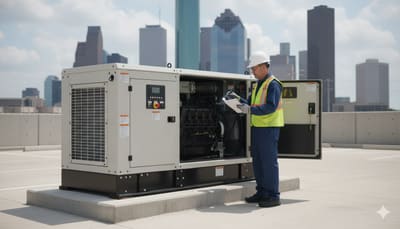
A commercial standby generator only earns its keep if it starts, picks up the building load and runs for as long as the outage lasts. The commercial generator maintenance best practices below give facility managers a practical routine: what to check weekly and monthly, what a technician should handle, how to keep diesel fuel usable, and how to prepare before Houston’s hurricane season.
In this guide
Why maintenance discipline matters for a business
A home generator that fails during a storm is a miserable inconvenience. A commercial unit that fails can mean spoiled inventory, a dark data closet, elevators that stop, refrigeration that warms up and tenants or patients who depend on you. The engine and alternator are rarely the first thing to go. Far more often the failure starts with something small and predictable: a weak starting battery, a clogged fuel filter, a coolant leak, a transfer switch nobody has operated in a year.
That is good news, because predictable failures are preventable. The facilities that ride out outages well tend to share three habits: they follow a written schedule, they run the generator the way it will actually be used, and they write everything down.
Build a preventive maintenance schedule
Start with the manufacturer’s maintenance manual for your specific engine and alternator. It sets the intervals for oil, filters, coolant, belts and inspections, usually as “every X months or Y run hours, whichever comes first.” Then layer your own site conditions on top. A generator in a dusty yard or a salty, humid location may need shorter intervals than the manual’s baseline.
A workable structure for most commercial sites looks like this:
| Frequency | Who | Typical tasks |
|---|---|---|
| Weekly | Facility staff | Walk-around for leaks, alarms, debris and animal activity; confirm the controller is in Auto; note battery charger status and fuel level |
| Monthly | Staff or technician | Exercise run under load; check fluid levels, belts and hoses; drain water separators; record readings |
| Every few months | Technician | Inspect fuel system, cooling system, battery and connections; review controller fault history; test the transfer switch |
| Annually | Technician | Full service per the manual (oil, filters, coolant checks, valve and injector items as specified); load bank test if needed; full transfer test |
Treat this table as a starting framework, not a replacement for the manual. If your generator powers life-safety systems, the required intervals may be set by code rather than by preference.
Exercise the generator under load
Most automatic controllers run a scheduled exercise, but many are set to run with no building load connected. For a diesel engine, that light-duty running is not ideal. An engine that never warms up fully can suffer from wet stacking, where unburned fuel and soot collect in the exhaust system, and from carbon buildup on injectors and valves.
Better practice is a monthly exercise under a real load, ideally by transferring part or all of the building to generator power for at least half an hour. For systems covered by NFPA 110, the standard that governs many emergency power installations, the monthly test has specific load and duration requirements; your engineer or the local authority having jurisdiction can confirm which apply to you.
During the run, have someone note:
- Time from start signal to stable voltage and transfer
- Oil pressure, coolant temperature, voltage and frequency
- Any alarms, warnings or unusual noises
- Exhaust color and any leaks around the exhaust or fuel lines
- Retransfer to utility and cooldown behaving normally
If something looks different from last month, that is a reason to schedule generator diagnostics now rather than after the next outage.
Diesel fuel quality management
Diesel is the most common fuel for larger commercial standby units because it stores on site. The catch is that stored diesel does not stay perfect forever. Today’s ultra-low-sulfur diesel and biodiesel blends can absorb moisture, and Houston’s humidity means condensation forms inside tanks as temperatures swing. Water at the bottom of a tank supports microbial growth, often called “diesel bug,” which produces sludge that plugs filters right when the engine is working hardest.
Sound diesel fuel management comes down to a few habits:
- Keep tanks full. Less air space means less condensation.
- Drain water regularly from the tank sump and from the engine’s water separator.
- Sample and test fuel on a regular schedule, and after any event that might have let water in, such as flooding.
- Polish or replace fuel when tests show water, sediment or microbial contamination.
- Rotate fuel through use where practical, and ask your supplier about additives suited to long-term storage.
- Plan refueling before storm season, including how deliveries will reach you if roads flood.
Natural gas units avoid storage problems but depend on the gas utility staying up, so their maintenance focus shifts to regulators, valves and ignition parts.
Coolant, block heaters and batteries
Cooling system. Check coolant level and condition, look for weeping hoses and clamps, and keep the radiator core clean. Houston yards collect leaves, pollen and grass clippings that blanket a radiator and push an engine toward high-temperature shutdowns during a long summer outage. Coolant should be tested and replaced on the manufacturer’s schedule.
Block heaters. Many diesel standby units use an engine block heater so the engine starts quickly and takes load without strain. A failed heater often goes unnoticed until a cold snap like Winter Storm Uri in February 2021. Feel the block or check the heater’s circuit during routine walk-arounds, and confirm the heater has power.
Batteries. Weak starting batteries are among the most common reasons a standby generator fails to start. Heat shortens lead-acid battery life, so Gulf Coast batteries often wear out sooner than you might expect. Good practice includes:
- Cleaning and tightening terminals and checking for corrosion
- Verifying the battery charger is working and set correctly
- Load testing batteries rather than relying on a voltage reading alone
- Replacing batteries on a planned schedule instead of waiting for a no-start
When parts do wear out, using components approved by the equipment manufacturer keeps the system behaving as designed. Our generator parts and replacement services cover batteries, chargers, filters, belts and more.
Load bank testing
A load bank test connects a portable bank of resistors (and sometimes reactive elements) to the generator so it can be run at a high, controlled percentage of its rating. It answers a question the monthly exercise often cannot: will this generator actually carry its full rated load for an extended period?
Load bank testing is especially useful when:
- Your building load is light compared with the generator’s rating, so normal exercise never works the engine hard.
- The generator has shown signs of wet stacking.
- Major repairs have been made and you want proof of capacity.
- An inspector, insurer or tenant contract asks for documented capacity testing.
A typical test steps up the load in stages while a technician records temperatures, pressures, voltage and frequency at each step. The results become part of your maintenance file.
Records and staff roles
Good records turn a generator from a black box into something you can manage. Keep one log, paper or digital, with every exercise run, inspection, service visit, alarm, fuel delivery, fuel test and part replacement. Over time, trends emerge: slowly rising oil use, a battery that takes longer to recharge, a start time that keeps creeping up.
Clarify who does what before an emergency:
- Owner of the programOne named person is responsible for making sure scheduled tasks happen and records are kept.
- Weekly checkerA trained staff member does walk-arounds and knows how to read the controller display and recognize an alarm.
- Service partnerA qualified technician handles preventive maintenance, load testing and repairs, and can be reached any time.
- Outage contactSomeone on every shift knows how to confirm the generator is running, where the fuel level gauge is, and who to call.
Post a simple one-page outage procedure near the generator controls and the transfer switch, including the service phone number.
Hurricane-season preparation
The Atlantic hurricane season runs from June 1 to November 30, and Hurricane Beryl in July 2024 was a reminder that long outages can hit the Houston area early in the season. Schedule your major annual service in the spring so any repairs are finished before June. Then, as the season begins:
- Top off diesel and confirm a refueling plan
- Run a full load transfer test
- Clear vegetation and debris around the enclosure
- Confirm drains and louvers are not blocked
- Check spare filters and fluids on site
- Review the outage procedure with staff
After a storm, inspect for water intrusion, debris in the radiator and damaged wiring before relying on the unit for an extended run.
When to call a professional
Facility staff can handle walk-arounds, logs and basic checks, but oil and coolant service, fuel system work, load bank testing, controller programming and transfer switch repairs belong with a trained technician. JaWilly Services provides commercial generator services for businesses in Houston, Pasadena, Katy and surrounding communities, from scheduled maintenance to 24/7 emergency generator support when a unit will not cooperate. Our certified technicians work on most major makes and models and give you an upfront quote before work starts.
Ready to put a maintenance routine in place? Contact JaWilly Services or call or text 832-418-7218.