
How to Choose a Commercial Generator: A Buyer's Guide for Business Owners
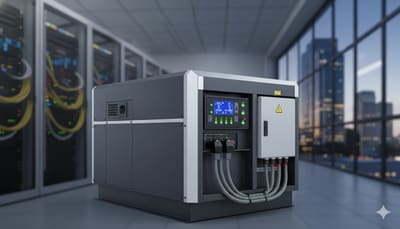
Knowing how to choose a commercial generator comes down to answering a handful of questions in the right order: which loads truly must stay on, how much power and what kind of electrical service they need, which fuel you can count on during a long outage, and what the unit will cost to own over its life. This guide works through each decision so you can talk to engineers and installers with clear priorities.
In this guide
Start with critical loads
The most expensive mistake is buying a generator for “the whole building” without deciding what the business actually needs during an outage. Walk through your operations and sort loads into three groups:
- Must run: life-safety and security systems, refrigeration and freezers, servers and network equipment, point-of-sale, medical or lab equipment, sump and lift pumps.
- Should run: HVAC for occupied areas, lighting for work areas, elevators, key production equipment.
- Can wait: decorative lighting, non-essential HVAC zones, break room appliances, equipment that can be shut down safely.
A generator sized for the first two groups, with the third left off or shed automatically, is often much smaller and less costly than one sized for everything. The final load list also drives decisions about transfer switches, since critical and non-critical circuits may be separated.
Understand kW, kVA and motor starting
Commercial generators list two ratings:
- kW (kilowatts) is real power, the energy your equipment converts into work, light or heat.
- kVA (kilovolt-amperes) is apparent power, which includes the reactive current that motors, transformers and similar equipment draw.
Industrial generators are commonly rated at a 0.8 power factor, which is why a unit’s kVA number is higher than its kW number. Your load study should account for both.
Motor starting is often the real sizing constraint. Large motors in compressors, chillers, pumps and elevators can draw several times their running current for a moment when they start. If the generator cannot supply that surge, voltage dips, lights flicker, contactors drop out and sensitive equipment may reset. Soft starters, variable frequency drives and staggered starting sequences can reduce the impact. Equipment with switching power supplies, such as UPS systems and VFDs, can also introduce harmonics that affect alternator selection. These are good reasons to rely on a professional load calculation rather than adding up nameplates.
Single-phase vs three-phase and voltage
Your generator must match your building’s electrical service.
| Service type | Common voltages | Typical buildings |
|---|---|---|
| Single-phase | 120/240V | Small offices, small retail, converted homes |
| Three-phase | 120/208V | Offices, restaurants, light commercial |
| Three-phase | 277/480V | Larger commercial, industrial, warehouses |
Three-phase power delivers smoother power to large motors and is standard for most commercial buildings of any size. Check your main switchgear or utility meter information before talking to vendors, and confirm the generator’s voltage, phase and connection type match.
Diesel vs natural gas vs bi-fuel
| Fuel | Strengths | Watch-outs |
|---|---|---|
| Diesel | Fuel stored on site; strong response to large load steps; long engine life when maintained | Fuel must be tested and maintained; tank rules apply; emissions regulations; refueling logistics in long outages |
| Natural gas | No on-site storage or refueling; cleaner burning; quieter in many designs | Depends on gas utility pressure and supply; often larger and slower to accept big load steps for the same output |
| Bi-fuel | Starts on diesel, then blends in natural gas to stretch stored fuel | More complex controls and maintenance; still needs a diesel supply |
| Propane | Stores well on site; useful where natural gas isn’t available | Tank sizing and vaporization in cold weather; tank placement rules |
In the Houston area, both outage patterns matter. Hurricanes and tropical storms can make fuel deliveries difficult for days, which favors pipeline gas. Winter Storm Uri in February 2021 showed that gas supply systems can also be stressed, which favors on-site storage for the most critical facilities. Some businesses split the difference with bi-fuel units or a natural gas generator paired with a smaller diesel unit for life-safety loads.
Runtime and fuel storage
Ask how long you need to run without help. For diesel, that sets tank size; a sub-base tank under the generator is common for smaller and mid-sized commercial units, while larger installations may use separate tanks. Consider:
- How many hours or days of runtime at your expected load, not the generator’s full rating
- How quickly a fuel supplier could realistically reach you after a hurricane
- Secondary containment, venting and local fire code rules for stored fuel
- Fuel maintenance, since diesel that sits for long periods needs testing and care
Enclosure, sound and placement
Commercial generators come in weather-protective, sound-attenuated and fully walk-in enclosures. Choose based on:
- Neighbors and local noise ordinances, especially near residences, hotels or medical offices
- Flood exposure, since a generator on an at-grade pad in a flood-prone lot may need to be elevated
- Wind and debris during tropical storms
- Corrosion, particularly near the Ship Channel and other industrial or coastal areas
- Clearances for airflow, exhaust, service access and code-required separation from openings
- Rooftop vs ground placement, which affects structural design, fuel piping and access
Code and regulatory considerations
The National Electrical Code separates emergency systems, legally required standby systems and optional standby systems, and each has different requirements for transfer switches, wiring and testing. Facilities with life-safety or emergency power systems may also fall under NFPA 110, which covers performance and maintenance of emergency power supply systems. Stationary diesel engines are subject to EPA emissions rules, and fuel storage is governed by fire codes. Local permits and utility coordination are typically required.
Your design engineer and the local authority having jurisdiction determine what applies. The practical takeaway: identify early whether your generator serves life-safety loads, because that affects equipment selection, transfer switch arrangement and ongoing testing obligations.
Scalability and paralleling
Businesses grow, and loads change. If you expect to add equipment, a building wing or another tenant, plan for it now:
- Size with headroom for known expansion.
- Leave physical space, conduit and pad room for a second unit.
- Consider paralleling-capable generators, which can be combined to share load and provide redundancy so one unit can be serviced while another stays available.
Redundancy is worth considering for operations where any loss of power is unacceptable. It also simplifies maintenance, because one generator can be taken offline for service while the other stays ready. For smaller sites, a simpler hedge is a docking station or portable generator connection point that lets a rental unit be connected quickly if the permanent generator is down for repairs.
Total cost of ownership
The purchase price is only one line. A fair comparison between options includes:
- InstallationPad or structural work, fuel piping or tanks, transfer switches, electrical work, permits and commissioning.
- FuelConsumption during testing and outages, plus fuel maintenance for stored diesel.
- MaintenanceScheduled service, load bank testing, batteries, filters, coolant and belts over the unit's life.
- Monitoring and complianceRemote monitoring, inspections and record keeping.
- Downtime riskWhat an hour or a day without power costs your business, which puts the other numbers in perspective.
When to call a professional
Choosing a commercial generator involves load studies, electrical design and code questions that are best answered with qualified professionals. JaWilly Services provides commercial generator services including installation, maintenance and ongoing support for businesses in Houston, Sugar Land, Pasadena and surrounding communities. Our certified technicians work on most major makes and models, use OEM-approved replacement parts, and provide upfront quotes with no hidden fees.
To talk through your business’s backup power needs, contact JaWilly Services or call or text 832-418-7218.