
Commercial Generator Installation in Houston: The Step-by-Step Process
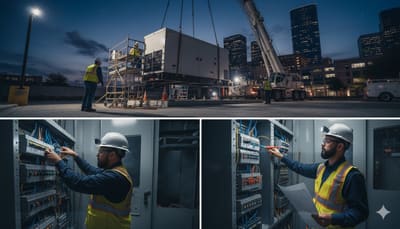
Commercial generator installation is a project, not a delivery. A reliable result comes from a sequence of steps, from measuring what the building actually needs to proving the system works under load, and each step depends on the one before it. This guide walks Houston-area business owners and facility managers through that sequence so you know what to expect and what to ask.
If you are still deciding which kind of generator to buy, start with our guide on how to choose a commercial generator. This article picks up once you’re ready to plan the installation itself.
In this guide
- Step 1: Load study and critical loads
- Step 2: Sizing the generator and switchgear
- Step 3: Planning the fuel supply
- Step 4: Site, pad and placement
- Step 5: Permits and utility coordination
- Step 6: Choosing and wiring the transfer switch
- Step 7: Commissioning and load testing
- Step 8: Training and maintenance handoff
- When to call a professional
Step 1: Load study and critical loads
Everything else in the project is built on one question: what does this generator need to power?
Start by listing the equipment that must keep running during an outage. For an office that might be servers, network gear, lighting, security and some HVAC. For a restaurant, walk-in coolers and freezers matter most. For a light industrial site, it could be specific production lines, pumps or compressors. Then separate the list into tiers:
- Life-safety loads such as emergency lighting and fire alarm systems, which may have their own code requirements
- Critical business loads that cause losses or safety problems if they stop
- Convenience loads that would be nice to keep but aren’t essential
A load study puts numbers on that list. It can be done by reviewing a year of utility demand data, by metering the building’s panels or by calculating loads from nameplate data. The key detail many people miss is starting current: large motors in compressors, chillers and pumps draw several times their running current for a moment at start-up, and the generator has to absorb that surge without its voltage collapsing.
Step 2: Sizing the generator and switchgear
With the load study in hand, the generator can be sized in kW (real power) and kVA (apparent power), and the electrical characteristics confirmed: voltage, single-phase or three-phase, and how the system will connect to the building’s service.
Getting the size right matters in both directions. An undersized generator trips its breaker or stalls when big motors start. An oversized one costs more up front and, if it spends its life lightly loaded, diesel units in particular can suffer from wet stacking, a buildup of unburned fuel in the exhaust system. A good design leaves reasonable headroom for growth without going overboard.
Sizing also covers the switchgear: transfer switch ampacity, breakers and conductors all have to match the generator and the loads they will carry.
Step 3: Planning the fuel supply
The fuel decision affects runtime, maintenance and site layout.
| Fuel | Installation considerations |
|---|---|
| Natural gas | Needs adequate gas service and pressure at the site; the gas utility may need to upgrade the meter or line. No on-site storage to refill. |
| Diesel | Requires an on-site tank, often a sub-base tank under the generator. Tank sizing sets runtime, and fuel quality must be managed over time. |
| Propane | Needs on-site tank placement with required clearances; refill access for delivery trucks. |
| Bi-fuel | Combines diesel with natural gas; more complex fuel plumbing and controls. |
For natural gas, confirm early that the existing gas service can deliver enough volume at the right pressure when the generator is at full load alongside other gas appliances. For diesel, decide how many hours of runtime you want on site, and plan for how you’d get refueled if a storm closes roads for days.
Step 4: Site, pad and placement
Where the generator sits affects safety, noise, service access and resilience. Points to settle during site planning:
- Clearances from building openings, air intakes and property lines per the manufacturer and local code
- A properly designed concrete pad or mounting surface able to carry the unit's weight
- Elevation above expected flood levels, a serious consideration across much of the Houston area
- Access for a crane or forklift during setting, and for technicians and fuel deliveries afterward
- Exhaust direction and sound attenuation, especially near neighbors or occupied spaces
- Protection from vehicle traffic with bollards where needed
- Rooftop or indoor installations, which bring structural, ventilation and exhaust requirements of their own
Flood exposure deserves special attention here. A generator that sits low in a parking lot can be knocked out by the same storm it is supposed to protect against. Raising the pad, choosing a higher location or protecting conduits and fuel connections can make the difference.
Step 5: Permits and utility coordination
Commercial generator projects usually require permits, and the exact mix depends on where the building is. The City of Houston, surrounding cities such as Katy, Sugar Land, Pearland and Pasadena, and unincorporated county areas each have their own processes. Typical reviews may include:
- Electrical permits for the generator connection and transfer equipment
- Fuel-related review for gas piping or on-site fuel storage
- Fire code review, particularly where the generator supports life-safety systems
- Zoning, setback or noise considerations, and in some cases air-quality requirements
Some facilities, such as healthcare settings, have emergency power requirements based on standards like NFPA 110, which affect how the system is designed, tested and documented. If your facility falls into one of those categories, make sure those requirements are identified at the start of design rather than discovered at inspection.
Coordination with the electric and gas utilities may also be needed, for example to schedule a service shutdown during tie-in or to upgrade a gas meter. Building these lead times into the schedule avoids surprises.
Step 6: Choosing and wiring the transfer switch
The automatic transfer switch (ATS) is the brain of a standby installation. It watches utility power, signals the generator to start when power fails, moves the load over once the generator is stable, and moves it back when utility power returns.
Choices to make include:
- Open transition vs. closed transition. Open transition briefly drops the load during transfer; closed transition can return to utility without a blink, which suits sensitive operations.
- Service-entrance rated or not, depending on where the switch sits in the electrical system.
- Number of switches. Larger buildings may use separate switches for life-safety, critical and optional loads.
- Load shedding to drop lower-priority loads if the generator approaches its limit.
- Remote monitoring so staff are alerted to outages, faults and low fuel.
Step 7: Commissioning and load testing
Commissioning proves the system works as designed before you depend on it. A thorough start-up typically includes:
- Pre-start inspectionFluids, battery, fuel connections, wiring terminations, and controller settings are verified.
- Initial start and no-load checksVoltage, frequency, phase rotation and safety shutdowns are confirmed.
- Load bank testingA portable load bank applies a controlled load, often in steps up to full rating, to confirm the generator can carry its rated output.
- Building load testUtility power is interrupted in a controlled way so the ATS, generator and building loads are tested together, including retransfer and cooldown.
- DocumentationTest results, settings and as-built information are recorded for the owner and any inspections.
Step 8: Training and maintenance handoff
A generator is only as reliable as the routine that follows installation. Before the project closes, your staff should know how to read the controller, what the normal exercise cycle looks like, how to respond to common alarms and who to call when something looks wrong.
Ask for a written maintenance schedule based on the manufacturer’s requirements, and set it up from day one. Our article on commercial generator maintenance best practices covers what a good long-term program looks like. Keep a log of runs, faults and service visits; it will save time during inspections and troubleshooting.
When to call a professional
Commercial generator work involves high voltage, fuel systems and code requirements, so the design, wiring and commissioning belong with qualified professionals. Bring an installer in early, ideally before you commit to equipment, so the load study and site evaluation drive the decision.
JaWilly Services provides commercial generator installation, maintenance and support for businesses in Houston, Katy, Sugar Land, The Woodlands, Pearland, Pasadena and surrounding communities, with transparent pricing and upfront quotes. Explore our commercial generator services, see how we handle generator diagnostics for existing systems, or contact us to talk through your project. Call or text 832-418-7218, or email Jawillyservices@gmail.com for non-urgent requests.