
How to Choose a Commercial Generator Service Provider in Houston
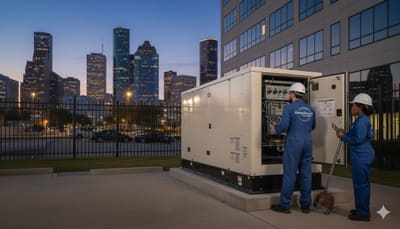
Choosing a commercial generator service provider Houston businesses can rely on comes down to four things: a clearly defined service scope, real emergency response, honest and documented pricing, and records that will stand up to an inspector or insurer. A generator protects revenue, inventory, data and sometimes lives, so the company that maintains it deserves the same scrutiny you would give any critical vendor. This guide gives facility managers and owners a practical framework for comparing providers.
In this guide
Why the provider matters as much as the generator
A commercial standby generator can sit idle for months, then be asked to carry an entire building with no warning. Whether it succeeds depends heavily on the work done during those quiet months: fuel kept clean, batteries replaced on time, the transfer switch exercised and small leaks fixed before they turn into shutdowns.
When outages hit a whole region at once, as they did during Winter Storm Uri in February 2021 and Hurricane Beryl in July 2024, every generator owner calls for help at the same time. Businesses that already have an established relationship with a service provider, with their equipment details and history on file, are in a far better position than those starting from a search engine.
What a full service scope looks like
When you compare providers, look at the whole range of work they can handle, not just the price of a routine visit. A complete commercial service relationship typically covers:
- Scheduled preventive maintenance
- Fluid, filter and battery service
- Fuel system inspection and fuel quality checks
- Automatic transfer switch inspection and testing
- Load testing or load bank testing where required
- Diagnostics and repair
- Replacement parts that meet manufacturer specs
- Emergency response during outages
- Written reports after every visit
- Installation and upgrades as needs change
Preventive maintenance
This is the backbone of the relationship. Ask what is included on each visit and how the schedule follows your manufacturer’s recommendations. The specific tasks are covered in our post on commercial generator maintenance best practices.
Load bank testing
Many commercial generators run their scheduled exercise with little or no load. Diesel engines in particular can suffer from “wet stacking,” where unburned fuel and carbon build up in the exhaust when the engine runs too lightly for too long. A load bank test connects a controlled artificial load so the generator proves it can deliver its rated output. Ask whether a provider performs it directly or arranges it.
Emergency response
Ask how emergency calls are handled after hours, on weekends and during a regional outage. A provider that offers 24/7 support and already knows your equipment can get your site back online faster.
Questions to ask a commercial generator service provider in Houston
- What equipment do you service?Confirm experience with your generator's make, size, fuel type (diesel, natural gas or propane) and transfer switch.
- How do you schedule maintenance?Ask whether visits are planned around your operating hours and how far ahead they are booked.
- What happens during an outage?Find out how to reach the provider after hours and how calls are prioritized.
- How is pricing presented?You want upfront quotes for repairs and a clear breakdown of what routine visits include.
- What reports will I receive?Ask to see a sample service report before you sign anything.
- How are your technicians trained?Commercial equipment changes, and ongoing training keeps technicians current on controllers and newer models.
- Can you support installation and upgrades?If your load grows or your unit nears the end of its life, a provider who can also handle installation keeps continuity.
Contract considerations
A service agreement is only as useful as its details. Before you sign, read for:
- Covered equipment. Every generator, transfer switch and fuel tank should be listed by make, model and serial number.
- Visit frequency and scope. “Quarterly maintenance” means little unless the tasks are spelled out.
- Parts and labor. Know which items are included and how additional parts and repairs are quoted and approved.
- Emergency terms. Understand how after-hours calls are handled and billed.
- Reporting. Specify the format and timing of reports and who receives them.
- Term and renewal. Watch for automatic renewals and know how to exit if service falls short.
Avoid agreements that promise everything in vague language. Specific, written terms protect both sides and make expectations clear before the next storm.
Documentation for inspections and insurance
For many businesses, the paperwork matters almost as much as the work. Hospitals, care facilities, high-rises and other buildings with life-safety loads may fall under codes like NFPA 110, which sets requirements for emergency and standby power system performance, including testing and maintenance. Local fire marshals, accreditation bodies and insurers may ask to see proof.
Good service records typically include:
| Record | What it shows |
|---|---|
| Visit reports | Date, technician, tasks completed, readings and findings |
| Run and exercise logs | Run hours, load during tests and any alarms |
| Load test results | Output delivered, duration and pass or fail |
| Repair history | Parts replaced and the reason for each repair |
| Recommendations | Open items and the date they were addressed |
Keep copies on site and in the cloud. When an inspector or insurer asks, you should be able to produce them in minutes, not days.
Red flags when comparing providers
Some warning signs show up during the sales conversation, long before the first service visit. Be cautious if a provider:
- Cannot show you a sample report. If they cannot show what documentation looks like, assume you will not get much of it.
- Offers a flat package without seeing your equipment. A credible plan starts with a site visit or at least the make, model, size and age of each unit.
- Is vague about after-hours support. “Call us anytime” means little without a clear process for reaching a technician on a holiday weekend.
- Prices repairs only after the work is done. Upfront quotes and an approval step should be standard for anything outside the agreed scope.
- Focuses only on the generator. The transfer switch, fuel supply and battery charger fail too, and a provider that ignores them leaves gaps.
- Recommends replacement at every visit. Sometimes an aging unit really should be replaced, but that advice should come with findings and test results, not as a sales script.
A good provider welcomes questions, explains what they find in plain language and treats your maintenance history as shared information rather than something you have to request.
Houston-specific factors
The Houston area adds a few considerations to any commercial service plan:
- Heat and humidity shorten battery life and accelerate corrosion on terminals and connections, so battery service should not be skipped.
- Hurricane season runs June 1 through November 30. Schedule a thorough inspection and fuel check in spring, and confirm your fuel delivery plan for an extended outage.
- Flooding risk affects where equipment sits, so ask your provider to flag any components at risk.
- Industrial corridors like the Pasadena and Ship Channel area often have larger, more complex equipment and stricter documentation needs, while retail and office sites in Katy or Sugar Land may need service planned around customer hours.
When to call a professional
If you are setting up a service relationship for the first time, or your current provider is not delivering clear reports and prompt response, it is worth a conversation. JaWilly Services provides commercial generator services including installation, maintenance and support, along with generator diagnostics, repairs and OEM-approved parts replacement for most major makes and models.
Our pricing is transparent, with upfront quotes and no hidden fees. Call or text 832-418-7218 any time for emergency support, or contact us to discuss a maintenance plan for your facility.